
What Is Time and Attendance Software and How Does It Work?
Knowing when employees start and finish work sounds simple.
But once a business has multiple teams, shifts, locations or mobile employees, keeping an accurate attendance record can quickly become more complicated.
Missed clock-ins need to be corrected.
Leave needs to be considered.
Overtime needs to be reviewed.
Managers need to know whether employees were scheduled to work in the first place.
This is where time and attendance software comes in.
What is time and attendance software?
Time and attendance software is a digital system used to record, organise and review employee working-time information.
Instead of relying on handwritten registers, spreadsheets or disconnected clocking records, businesses can maintain attendance information in a structured system where managers can see what happened during the working day.
A typical attendance management system can help record:
- When an employee clocks in and out
- Where the employee clocked in
- Scheduled versus actual working times
- Late arrivals or early departures
- Missed clock-ins
- Overtime
- Attendance exceptions and corrections
- Leave that affects the working day
- Attendance reports for management or payroll preparation
For South African employers, maintaining reliable working-time records also has an important recordkeeping function. Section 31 of the Basic Conditions of Employment Act requires employers to keep certain employee records, including the time worked by each employee.
How does time and attendance software work?
Although systems differ, the basic process is usually straightforward.
1. The employee clocks in
Employees record the start or end of their working day through an approved clock-in method.
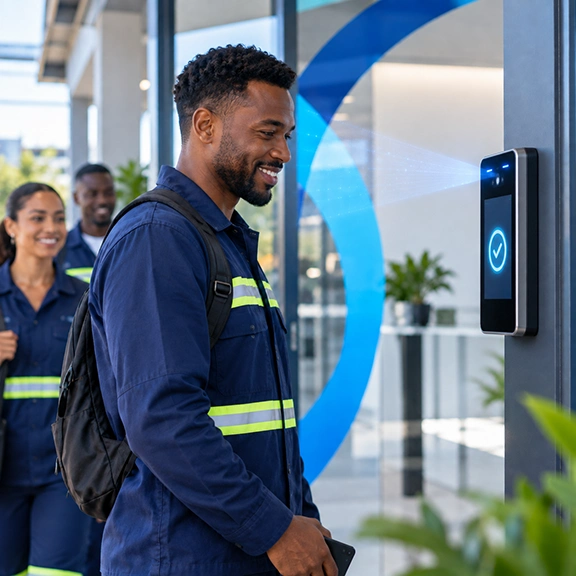
Depending on the workplace, this might include a biometric device, mobile application, tablet or another supported clocking method.
CONNECT supports flexible time and attendance processes for businesses that need to manage employees across different workplaces and working environments.
This can include options such as facial-recognition devices and mobile clock-ins, depending on what the employer has enabled.
2. The system records the attendance event
The system stores the clock-in or clock-out against the employee's attendance record.
Where mobile clocking or location-based controls are used, the system can also help businesses manage where employees are permitted to clock in.
This becomes particularly useful for businesses with employees working across multiple branches, client sites or other locations.
3. The record is compared with what was expected
The real value of time and attendance software is not simply collecting clock-ins.
Managers need context.
An employee arriving at 08:15 means very little unless you also know whether they were expected to start at 08:00, were on approved leave or had a different scheduled shift.
A structured attendance process helps businesses compare what was scheduled with what actually happened.
4. Exceptions can be reviewed
Missed clock-ins, lateness, unusual hours and other attendance exceptions can then be identified and reviewed instead of disappearing inside a spreadsheet.
This gives managers an opportunity to investigate and correct attendance information before it is relied on for reporting, payroll preparation or employee-management decisions.
It also helps create a more traceable process when attendance records need to be reviewed later.
5. Managers can report on the final record
Once attendance information has been reviewed, managers have a central source from which to retrieve reports and identify trends.
Instead of asking: "Which spreadsheet is correct?"
The goal is to have one structured attendance record showing what happened, what was corrected and what ultimately needs management attention.
Why does this matter?
A clock-in on its own is simply data.
The value comes from connecting that data to schedules, exceptions, leave, overtime, corrections and management review.
Without that context, businesses can have thousands of attendance records and still struggle to answer basic questions about the working day.
Good time and attendance software therefore helps create something more valuable than a digital clocking system:
Visibility, consistency and accountability.
For growing and multi-site businesses in particular, having one attendance management system can reduce reliance on fragmented tools while giving managers a clearer picture of what is happening across teams and locations.
CONNECT brings attendance management into a broader workforce-management platform, helping businesses move away from disconnected systems and towards structured, consistent and traceable employee management.
If your business is still managing attendance through spreadsheets, manual registers or disconnected systems, it may be worth asking a simple question:
Can your current attendance records tell you the full story of the working day?